Experiences
Pamukkale or Cappadocia? Two balloon skies, compared on regulated numbers
Turkey's two balloon regions compared on regulated figures — airspace slots, fleet size, and one passenger number that is officially not published.
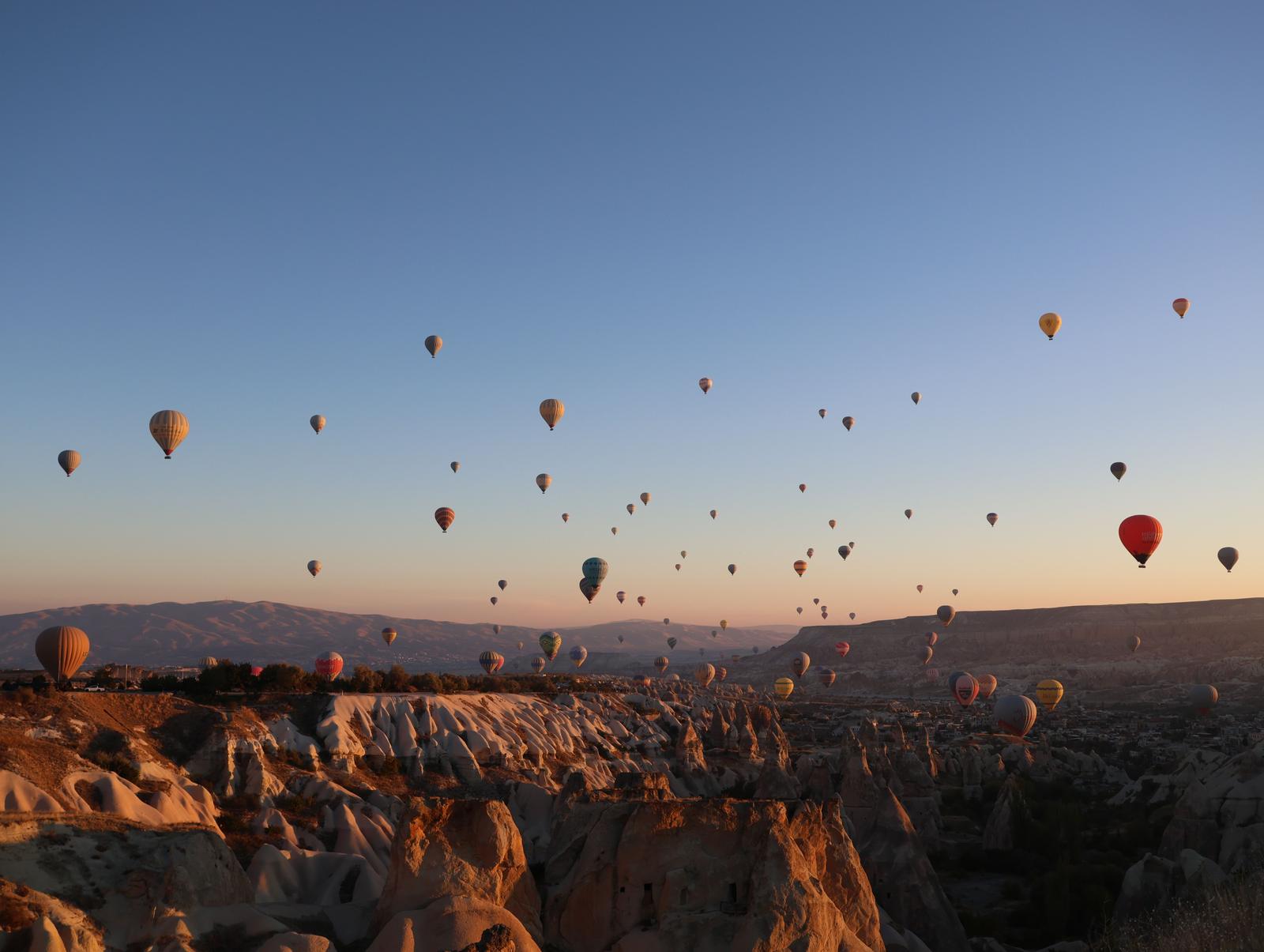
Most comparisons of these two skies are written with adjectives. This one is written with the numbers that Turkish civil aviation actually sets, because those are the only figures either side can be held to.
The regulated numbers
| Pamukkale | Cappadocia | |
|---|---|---|
| Balloons airborne at the same time | at most 40 | 156 |
| Morning slots | 40 | 100 |
| Fleet and operators | 19 licensed operators | 367 balloons registered in the region |
| Share of Turkey’s balloon flights | — | more than 80% |
| Passengers in 2024 | no official figure published | 769,814 on 31,851 flights |
The Pamukkale ceiling comes from article 13/1 of the binding instruction SHT-BALON-SLOT-PAMUKKALE: at most forty balloons in the air at any one moment. The share of national traffic is the Ministry of Transport and Infrastructure’s own statement. The 2024 Cappadocia figure was given by the Governor of Nevşehir.
The passenger number that does not exist
You will find a Pamukkale passenger total quoted on a good many travel sites. We do not quote it, for a simple reason: Turkish civil aviation does not publish balloon passenger statistics broken down by destination, and the circulating figure traces back to a company owner’s remark in a news report rather than to a published dataset.
An agency that repeats an unsourced number in order to look precise is telling you something about how it treats every other number on its site. So the comparison above uses slots and fleet — which are published and binding — and leaves the passenger row in Pamukkale empty, because that is the truthful state of the record.
What each sky is for
Cappadocia is scale. The photograph in almost everyone’s head — a horizon crowded with envelopes over eroded tuff valleys — is a Cappadocian photograph, and the slot allocation is why: a hundred morning slots and up to 156 balloons aloft together. If that density is the reason you want to fly, no other Turkish field reproduces it.
Pamukkale is the ground. Forty balloons is not a modest version of Cappadocia; it is a different experience with a different subject. What is beneath the basket is a UNESCO mixed World Heritage property, inscribed in 1988 as List No. 485 under criteria iii, iv and vii across 1,077 hectares — white travertine terraces and, on the ridge above them, the Roman city handed to Rome in 133 BC. Very few balloon fields anywhere lift off over a mixed World Heritage site.
What is identical in both places
- The flight is authorised on the morning itself, by the licensed operating company, at the launch field.
- Passenger flights share the same ground-wind ceiling of 10 knots.
- No agency in either region can promise you a specific date will fly. Anyone who does is selling a promise they do not control.
Because the constraint is the same, so is the planning rule: hold the balloon for the first morning of your stay in either region, and keep the following mornings free.
Choosing between them
If you have one balloon morning in the whole trip and you want the classic image, Cappadocia is the honest recommendation, and we will say so.
If you would rather fly over a World Heritage landscape with a regulated ceiling of forty balloons in the air — and combine the same trip with Hierapolis, Aphrodisias, Laodikeia or Ephesus, all reachable as day trips from the same base — Pamukkale is where our own operation is deepest.
Many routes through western and central Turkey pass through both regions, in which case the question is not which sky but which morning belongs to which. Tell us your dates and we will lay it out — by form or WhatsApp.
Background on how balloon mornings work, what is legally guaranteed and by whom: hot air balloon flights in Turkey.
Sources. SHGM instruction SHT-BALON-SLOT-PAMUKKALE, art. 13/1; Ministry of Transport and Infrastructure / SHGM figures on regional distribution, slot allocation and fleet; Governor of Nevşehir, 2024 Cappadocia passenger and flight totals; UNESCO World Heritage List entry no. 485, Hierapolis-Pamukkale. Checked 1 August 2026.
Updated: